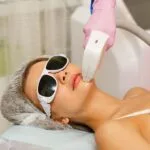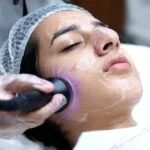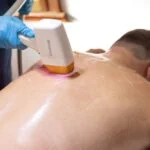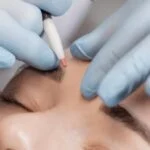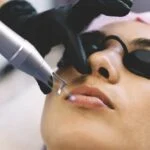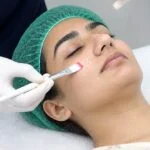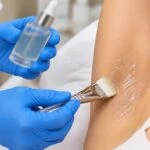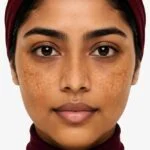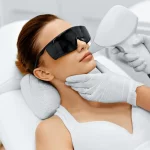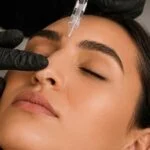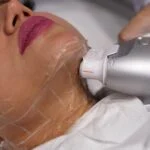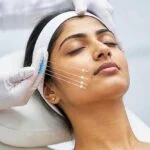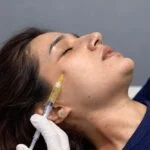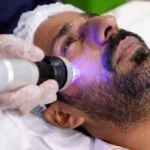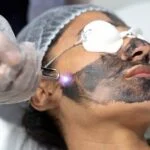
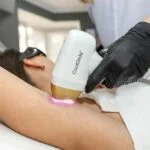

Marina wanted a break from waxing and shaving, so she chose CoolGlide.
What is facial laser hair removal and how does it work?
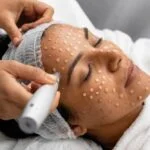
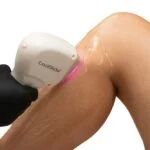
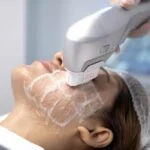
Facial laser hair removal uses light that homes in on the dark pigment in each hair; the heat damages the root that grows it, so fewer hairs return after every session. Coarse, dark chin hairs respond especially well, while finer upper lip hair takes a little longer. Our CoolGlide laser combines four wavelengths with 2000 W of power and a sapphire cooling tip, so your doctor can tune it for each part of your face, and many patients tell us they see a difference after the first session. Laser needs dark hair, so pale, grey or white hairs don’t respond.
Facial laser hair removal benefits
- Far less threading: upper lip and chin appointments become rare, then occasional.
- Long-term results: far less hair for the long term, with short top-ups if hormones bring hairs back.
- Quick sessions: the upper lip takes about 10 minutes, the full face about 15.
- No downtime: back to work straight after, and make-up again the next day.
- Fewer bumps and marks: no more plucking, so irritated follicles can settle.
- Suited to Pakistani skin tones: four wavelengths and sapphire cooling, set by your doctor for your skin.
Upper lip, chin and PCOS facial hair: can laser help?
Yes. Upper lip and chin hair are the most common reasons women come to us for facial hair removal. When hair is heavy, appeared suddenly or grows in a male pattern on the chin and jaw, polycystic ovary syndrome (PCOS) or another hormone condition is often behind it, and reviews advise checking hormones such as testosterone first. Laser still thins PCOS facial hair, but hormones keep stimulating the follicles, so treating the cause alongside and booking top-ups keeps your results going.
Facial laser hair removal before and after
After each session, treated hairs shed over two to three weeks, and regrowth comes back thinner, lighter and slower. Most women see clearly sparser hair after two or three sessions, and a course is usually 4–6 sessions about a month apart. In a study from Pakistan of 172 women with PCOS-related facial hair, laser improved quality of life, though hair often returned within six months, which is why hormone care and top-ups matter. Our patients share their own results in the videos below.
Facial laser hair removal price in Pakistan
Facial laser hair removal for the full face costs about Rs 4,900 a session in a course of 6, or Rs 6,995 for a single session. Smaller areas cost less: the upper lip is Rs 2,995 a session, or about Rs 2,100 a session in a course of 6. Prices are the same at all 12 of our clinics. Most people choose a six-session course, which saves 30%, so its price a session is highlighted in the table. For other areas, see laser hair removal price in Pakistan.
| Option | Single session | Course, a session |
|---|---|---|
| Upper lip or unibrow | Rs 2,995 | Rs 2,100Rs 12,579 for 6 sessionsSave Rs 5,391 |
| Eyebrows, forehead or nose | Rs 3,495 | Rs 2,400Rs 14,679 for 6 sessionsSave Rs 6,291 |
| Chin, cheeks, sideburns or ears | Rs 3,995 | Rs 2,800Rs 16,779 for 6 sessionsSave Rs 7,191 |
| Upper lip and chin | Rs 4,495 | Rs 3,100Rs 18,879 for 6 sessionsSave Rs 8,091 |
| Lip, chin and jawline | Rs 4,995 | Rs 3,500Rs 20,979 for 6 sessionsSave Rs 8,991 |
| Full face | Rs 6,995 | Rs 4,900Rs 29,379 for 6 sessionsSave Rs 12,591 |
| Courses that also cover the face | ||
| Full face and front of neck | Rs 8,995 | Rs 6,300Rs 37,779 for 6 sessionsSave Rs 16,191 |
| Face, underarms and bikini | Rs 15,995 | Rs 11,200Rs 67,179 for 6 sessionsSave Rs 28,791 |
Who shouldn’t have facial laser hair removal?
Treatment waits during pregnancy, while acne or a cold sore is active on the area, or after a recent tan, and laser won’t work on grey, white or very fair hair, which electrolysis can treat instead. Tell your doctor about any hormone treatment, isotretinoin or a tendency to cold sores.
Your facial laser hair removal, step by step
- Free consultation: your doctor looks at your hair pattern and asks about periods, PCOS and medicines.
- Preparation: shave or trim the area a day before, and put threading and waxing on hold.
- Treatment: your eyes are shielded and cooled pulses cover the area in 10–15 minutes.
- Course: usually 4–6 sessions about a month apart; some faces need a few more.
- Top-ups: short, occasional sessions whenever hormonal hair reappears.
Results and recovery
Any pink skin or small raised bumps around the follicles fade within a few hours to a day or two, and you can wear make-up again the next day. Hair thins session by session, and threading appointments become rare. The result is long-term hair reduction, but on a woman’s face hormones can wake new follicles over the years, so most women book a short top-up now and then to keep that clean look.
Aftercare
- No make-up for 24 hours
- Use sunscreen; avoid strong sun for 2 weeks
- Don’t thread, wax or pluck between sessions
- Skip steam rooms and saunas for a day
Why choose Cutera Aesthetics
- Doctor-led: your treatment is assessed, planned and performed by our qualified doctors, with female doctors at every clinic.
- Free consultation: an honest assessment and a clear plan before you commit to anything.
- Facial laser hair removal near you: at all 12 clinics in 7 cities, at the same price. Find your nearest clinic.
Sources
- American Academy of Dermatology. Laser hair removal: Overview. Why results on a woman’s face need repeat treatment.
- Bhat YJ, et al. Laser treatment in hirsutism: an update. Dermatology Practical & Conceptual, 2020; 10(2): e2020048.
- Sakina S, et al. Impact of laser therapy on the quality of life in women living with polycystic ovary syndrome-associated hirsutism: an observational study. Cureus, 2024; 16(5): e61125.
- Mittal R, et al. Evaluation of long-pulsed 1064 nm Nd:YAG laser-assisted hair removal vs multiple treatment sessions and different hair types in Indian patients. Journal of Cutaneous and Aesthetic Surgery, 2008; 1(2): 75–9.
- Yuan N, et al. Comparison of permanent hair removal procedures before gender-affirming vaginoplasty. Sexual Medicine, 2022; 10(5): 100545. How laser and electrolysis differ by hair colour and speed.