PRP for a Receding Hairline: Can It Help?
· Edited by Shahid Hussain

Your forehead looks a little higher in every photo, and the corners of your hairline have started to creep back.
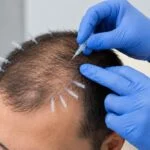
PRP can help a hairline that is thinning but still has hair, mostly in early pattern hair loss. It can’t regrow a fully bald area, and results need top-ups. In one half-head trial, three monthly sessions raised density by 45.9 hairs per square centimetre. Finding the cause comes first.1,2
Why does a hairline recede?
In men, the usual reason is hereditary hair loss, and a receding hairline is often its first sign.3 Hair roots in certain areas are sensitive to the hormone DHT, so they make finer, shorter hairs over time.4 Up to half of Caucasian men have some of this loss by 50, and rates differ between populations.4
Women usually thin all over or along the parting, so a receding hairline in a woman needs a closer look.3 Two causes matter in both sexes:
- Tight hairstyles. Continual pulling from buns, braids or ponytails can cause lasting hair loss.5
- Frontal fibrosing alopecia. This scarring condition is usually diagnosed in women after menopause, and men can get it too. Hair recedes along the front and sides, and eyebrows often thin. Early medical treatment can stop further loss.6
PRP isn’t the treatment for either of these, which is why the cause comes first.
Does PRP hair treatment work on a receding hairline?
The research on thinning scalps is encouraging. A review of 27 hair loss trials, 18 of them in pattern hair loss, found PRP raised hair density by 25.6 hairs per square centimetre more than salt-water injections, with no serious side effects.2 In a trial where PRP went on one half of the head and a placebo on the other, 20 people gained a mean of 45.9 hairs per square centimetre after three sessions.1
The honest limit: the review rated this evidence as low certainty, and we found no study that measured the hairline by itself.2 So your doctor can’t promise how your temples will respond, but can tell you whether the hair there is still alive enough to try.
Who does it suit?
Earlier is better. In a study of 51 men and 42 women, every grade improved over 6 months, and men at grades II and III and women at grade I responded better than those with more advanced loss.7 PRP is most likely to suit you if:
- Your hairline or temples are thinning, and fine hairs are still growing there.
- You’ve had a doctor confirm pattern hair loss.
- You can attend a course of sessions and come back for top-ups.
It isn’t right if you have a bleeding or platelet condition, take blood thinners, are having cancer treatment, have a scalp infection, or are pregnant.
What can’t PRP do?
- It can’t regrow a fully bald area where the hair roots have gone. A hair transplant is the option usually discussed there, and we don’t offer transplants.8
- It doesn’t stop genes and hormones from carrying on. In the half-head trial, 4 people reported progressive hair loss 12 months after the last treatment, and they were treated again.1
- It may not be enough by itself. Finasteride and minoxidil are the main treatments for male pattern baldness, though they don’t work for everyone, work only while you use them, and finasteride isn’t for women.9 Your doctor may suggest PRP alongside them.
How long do results take?
Hair grows slowly, so this takes patience. On our PRP hair treatment page, shedding usually slows within two to three months, and thinning areas look fuller at three to six months. For comparison, finasteride takes about 4 months to show improvement, and minoxidil about 6 to 12.8
Your scalp can feel tender for a day or two, and most people go back to work straight after a session.
PRP or PRGF for a receding hairline?
PRGF hair treatment is made from your own blood too, with the white blood cells left out. It’s our signature hair treatment. In a pilot study of 19 people given five injections, hair density and thickness had increased at one year, and the authors called for randomized trials.10 The lead author works for the developer of PRGF, and we found no head-to-head trial against PRP. Your doctor can explain which suits your hair.
What should I do next?
Take clear photos of your hairline in the same light now, then every few months, so you can judge changes fairly. Loosen tight hairstyles. Then get your scalp examined, because with hereditary hair loss, the earlier treatment starts, the better it works.3
Consultations for hair loss are free at all 12 of our clinics, and you can ask for a female doctor. A dermatologist consultation has a fee. You can read more about PRP hair treatment in Lahore and PRP hair treatment in Islamabad, including sessions and prices.
Medically reviewed by Dr Sadaf Saleem, Dermatologist, FCPS (Dermatology), PM&DC 62494-P; Dr Junaid Rabbani, Dermatologist, PM&DC 44510-S; and Dr Shegref Mushtaq, Dermatologist, FCPS (Dermatology), PM&DC 19827-N
- Gentile P, et al. The effect of platelet-rich plasma in hair regrowth: a randomized placebo-controlled trial. Stem Cells Transl Med, 2015.
- Cruciani M, et al. Platelet-rich plasma for the treatment of alopecia: a systematic review and meta-analysis. Blood Transfus, 2023.
- American Academy of Dermatology. Hair loss: Who gets and causes.
- DermNet. Male pattern hair loss.
- American Academy of Dermatology. Hair loss: Tips for managing.
- American Academy of Dermatology. Hair loss types: Frontal fibrosing alopecia overview.
- Qu Q, et al. Efficacy of platelet-rich plasma for treating androgenic alopecia of varying grades. Clin Drug Investig, 2019.
- American Academy of Dermatology. Hair loss: Diagnosis and treatment.
- NHS. Hair loss. Reviewed January 2024.
- Anitua E, et al. The effect of plasma rich in growth factors on pattern hair loss: a pilot study. Dermatol Surg, 2017.
Treatments in this article
Sessions, downtime and results for each, on its own page.


Related articles


Ready when you are
Book your free consultation
A doctor checks your skin, hair or body first. No obligation.











 Meet our 48 doctors
We usually reply within 15 minutes.