Hair Loss Treatment in Menopause: 4 Options That Can Help

Menopause hair loss is common: one study found pattern thinning in 52% of postmenopausal women. Falling estrogen probably plays a part, along with genes and age. Minoxidil has the strongest evidence. Anti-androgen tablets, PRP or PRGF, and treating low iron or thyroid problems can also help. See a doctor soon if your hairline recedes.1,2,3
Why does hair thin around menopause?
Menopause usually comes between 45 and 55, and it’s confirmed when you haven’t had a period for 12 months. Hair thinning and hair loss are among its listed symptoms.4,5 A 2026 review suggests that falling estrogen may shift the balance on the scalp towards androgens, though this is still a theory.2
The study behind the 52% figure examined 178 women aged 50 to 65 in Thailand. Most cases were mild: 73% were at the earliest grade. Women with a body mass index of 25 or more had higher odds of thinning.1
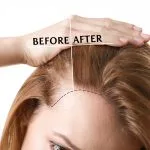
The usual first sign is overall thinning or a widening parting.6
What are the 4 options that can help?
1. Minoxidil lotion
This has the strongest evidence for female pattern hair loss. A Cochrane review covered 47 trials with 5,290 women. In the pooled minoxidil trials, about 26% reported moderate to marked regrowth, against 14% on placebo, and hair counts rose by about 13 hairs per square centimetre more.3 The 2% and 5% strengths worked about the same.3 It takes about 6 to 12 months to show, and the benefit stops if you stop using it.7
2. Anti-androgen tablets
A doctor may prescribe spironolactone, which works in about 40% of women with this type of hair loss, according to the American Academy of Dermatology.7 In a 24-week trial of 48 women who were also using minoxidil, 38% improved moderately or markedly on spironolactone, against 9% on placebo.8 Those women hadn’t reached menopause yet, so it’s less tested in your age group. Finasteride 1 mg did no better than placebo in women.3
3. PRP or PRGF hair treatment
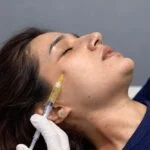
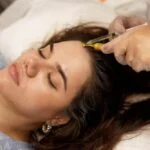
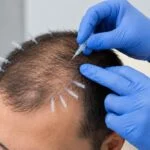
Both use your own blood. In pooled trials of hair loss, most of them in pattern hair loss, PRP hair treatment raised hair density by about 25.6 hairs per square centimetre more than salt-water injections, with no serious side effects.9 The certainty of that evidence is low, and the trials weren’t specific to menopause. In a study of 42 women, those with earlier thinning responded better.10 PRP isn’t suitable if you take blood thinners, so tell your doctor about your medicines.
4. Treating what’s adding to it
Low iron and thyroid problems can both thin hair.6,11 Treating thyroid disease can reverse the hair loss it causes.6 Blood tests show whether these apply to you. Take biotin, iron or zinc only if a test shows you’re low.7
Will hormone therapy help my hair?
The evidence doesn’t settle it. A 2026 systematic review called the effect on female pattern and overall hair loss unclear. Very small studies showed some benefit, and larger ones linked hormone therapy with higher odds of frontal fibrosing alopecia, a scarring type of hair loss.2 So decide on it for your menopause symptoms with your gynaecologist, and don’t count on it for your hair.
What about mesotherapy, Keravive or scalp threads?
Our hair fall treatment page covers these too. They aren’t on this list because the four above are the options we could back with published research on hair loss. Your doctor can tell you whether one would add to your plan.
When should I see a doctor about hair loss in menopause?
Go soon if your hairline is moving back along the front and sides of your head, especially if your eyebrows are thinning too. This can be frontal fibrosing alopecia, which is usually diagnosed after menopause.12 In the studies reviewed, at least 84% of cases were in postmenopausal women.2 Once a follicle has scarred it can’t grow hair again, but early medical treatment can stop further loss.12
Also book a visit if you have round bald patches, a sore or scaly scalp, or sudden heavy shedding. With hereditary hair loss, the earlier treatment starts, the better it works.6
Consultations for hair fall are free at all 12 of our clinics, with female doctors available, and a doctor checks your scalp and may order blood tests. A dermatologist consultation has a fee. See all our hair fall treatment options, or read about PRP hair treatment in Karachi.
Medically reviewed by Dr Sadaf Saleem, Dermatologist, FCPS (Dermatology), PM&DC 62494-P; Dr Junaid Rabbani, Dermatologist, PM&DC 44510-S; and Dr Shegref Mushtaq, Dermatologist, FCPS (Dermatology), PM&DC 19827-N
- Chaikittisilpa S, et al. Prevalence of female pattern hair loss in postmenopausal women: a cross-sectional study. Menopause, 2022.
- Roster K, et al. Menopause and common dermatoses: a systematic review. Am J Clin Dermatol, 2026.
- van Zuuren EJ, et al. Interventions for female pattern hair loss. Cochrane Database Syst Rev, 2016.
- NHS. Menopause and perimenopause.
- NHS. Symptoms of menopause and perimenopause.
- American Academy of Dermatology. Hair loss: Who gets and causes.
- American Academy of Dermatology. Hair loss: Diagnosis and treatment.
- Werachattawatchai P, et al. Efficacy and safety of oral spironolactone for female pattern hair loss in premenopausal women. Int J Womens Dermatol, 2025.
- Cruciani M, et al. Platelet-rich plasma for the treatment of alopecia: a systematic review and meta-analysis. Blood Transfus, 2023.
- Qu Q, et al. Efficacy of platelet-rich plasma for treating androgenic alopecia of varying grades. Clin Drug Investig, 2019.
- NHS. Hair loss. Reviewed January 2024.
- American Academy of Dermatology. Hair loss types: Frontal fibrosing alopecia overview.
Treatments in this article
Sessions, downtime and results for each, on its own page.



Related articles


Ready when you are
Book your free consultation
A doctor checks your skin, hair or body first. No obligation.









 Meet our 46 doctors
We usually reply within 15 minutes.